About
How does this work?
Initialize
Set your topic and upload your learning materials (text or PDF) and a custom rubric. Our system digests the content to build a specialized knowledge base for your session.
Practice
Interact with the adaptive pipeline. Your answers are graded with detailed feedback, while the system dynamically crafts follow-up questions based on your unique knowledge gaps.
Solidify
A custom FSRS algorithm schedules your reviews for optimal retention, moving you toward total mastery.
Tutorial
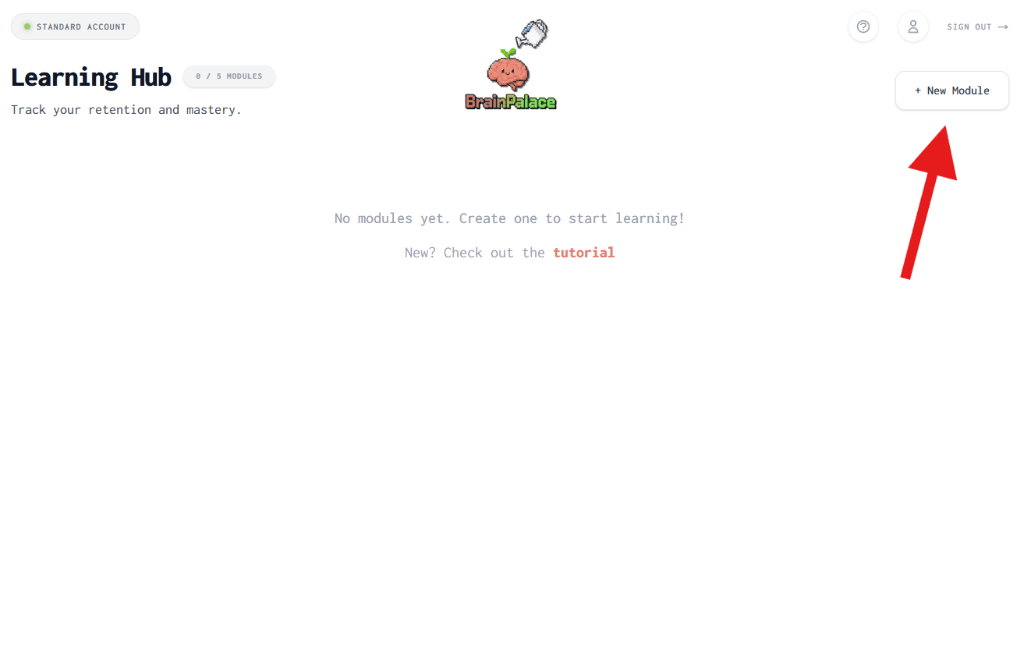
Step 1: New Module
Start by clicking New Module on your dashboard.
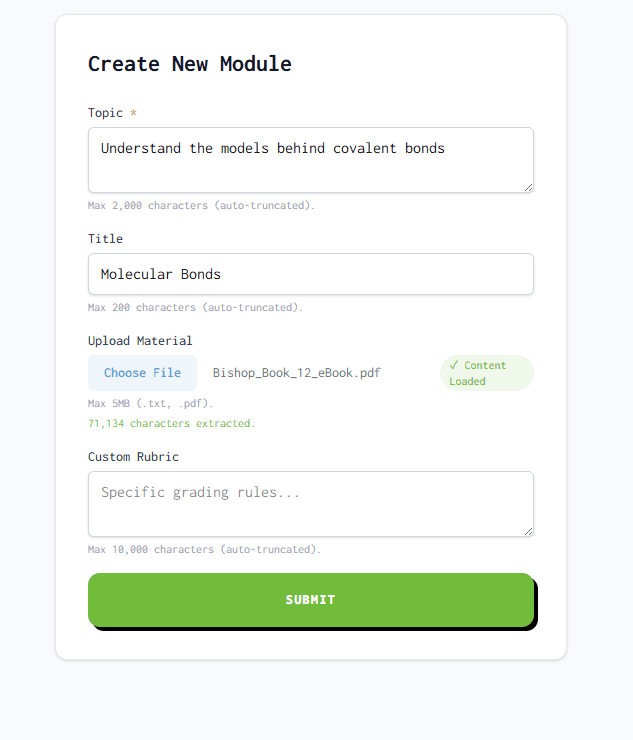
Step 2: Initialize
Set your topic, upload materials, and define a custom rubric.
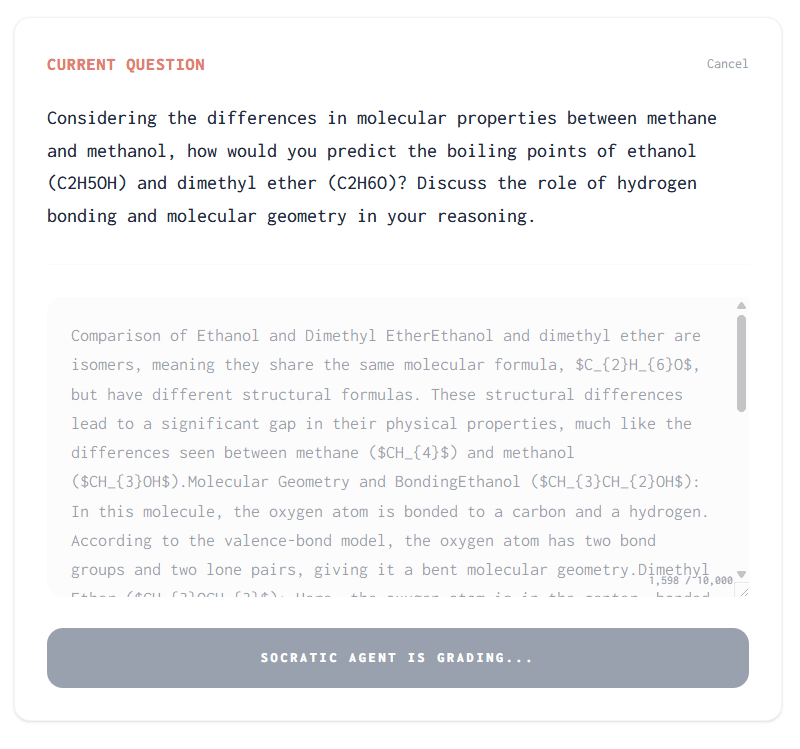
Step 3: Practice
Respond to tailored questions with detailed long-form answers.
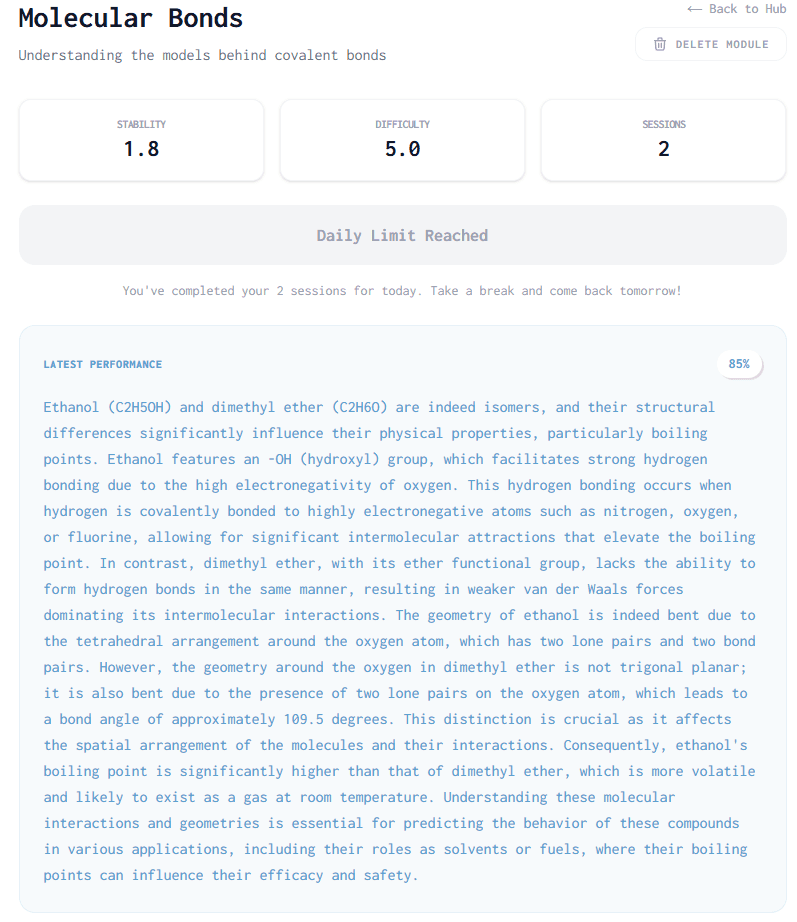
Step 4: Feedback
Receive expert-level narrative feedback and watch your mastery grow.
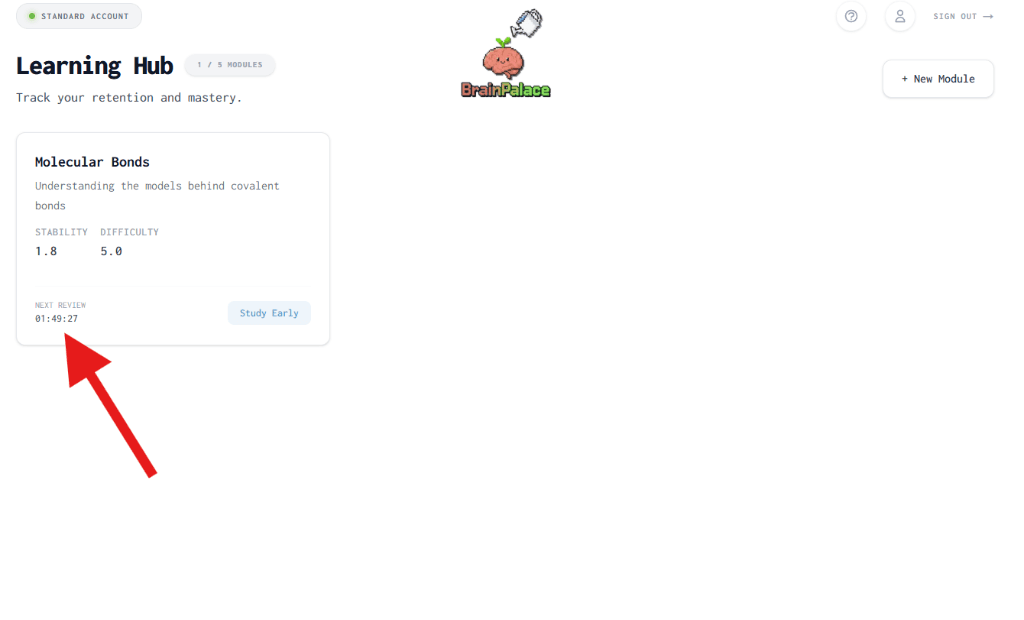
Step 5: Review
Review at your scheduled interval to solidify knowledge.
Science of Learning
Memory
What is FSRS?
The Free Spaced Repetition Scheduler (FSRS) is a scheduling algorithm that optimizes memory retention by modeling the human forgetting curve with high precision. It uses several key metrics to map your brain's relationship with information:
The time it takes for your recall probability to drop from 100% to 90% (represented in number of days). As you review correctly, Stability grows, and intervals between sessions lengthen.
Represents the complexity of a concept, from 1 to 10. Highly difficult items require more frequent reviews even as they become stable.
Your current probability of recalling the information. The algorithm targets your reviews when Retrievability is near 90% - a "critical" moment for long-term storage.
The exponential decay of memory. BrainPalace maps this curve to intercept your forgetting at the optimal time, ensuring efficient recall with minimal effort.
Daily sessions are limited to prevent cramming, ensuring your brain has time to digest information. In the interest of transparency, it also helps limit the costs of running the service :p
Spaced Testing Effect
Rereading and highlighting are largely passive forms of studying. By answering open-ended questions, it forces active recall. By forcing your brain to reconstruct information, you create longer lasting synaptic pathways.
Research Citations
Evidence-based learning
For those interested in the science behind learning, here are some resources:
"Ten Benefits of Testing and Their Applications to Educational Practice"
Roediger, H. L., Putnam, A. L., & Smith, M. A. (2011). Psychology of Learning and Motivation.
Highlights that frequent testing—even without feedback—improves long-term retention compared to study-only sessions.
"Spaced Repetition Promotes Efficient and Effective Learning of Polysyllabic Pseudowords"
Smith, C. D., & Scarf, D. (2017). Frontiers in Psychology.
"A Stochastic Model of Memory for Spaced Repetition"
Ye, J., et al. (2022). Technical Report on FSRS Algorithm v4.